Safety audits reveal a critical vulnerability: open perimeters.
This finding, echoed by county grand juries across California, highlights a truth that many school administrators have long suspected but struggled to address. The modern school campus—designed for openness, accessibility, and community—is inherently difficult to secure.
Yet the mandate is clear. California Education Code requires schools to develop comprehensive safety plans that address “strategies aimed at the prevention of, response to, and education about, potential incidents involving medical emergencies, including sudden cardiac arrest, and crime and violence on the school campus.”
State tracking warns of a rise in unauthorized trespassers bypassing front office screenings during school hours.
This is not a distant threat. It is happening now, in districts across California. And the consequences of inadequate security extend beyond immediate safety risks to include legal liability, reputational damage, and the erosion of parent and community trust.
At Secure Guard Security Services, we’ve spent 20 years protecting California schools, colleges, and educational campuses. We understand the unique challenges of educational environments—and the legal requirements that govern them.
Here’s what every school administrator needs to know about professional campus security.
The California School Safety Mandate: What the Law Requires
California law places specific obligations on K-12 schools, community colleges, and private postsecondary institutions regarding safety and security.
K-12 Schools and School Safety Plans
The Interagency School Safety Demonstration Act of 1985 ( Education Code Section 32260 et seq. ) requires every California public school to develop a comprehensive school safety plan. These plans must address:
- Prevention of, response to, and education about potential incidents involving crime and violence on campus
- Coordination with local law enforcement agencies, fire departments, and first responder entities
- Strategies for medical emergencies, including sudden cardiac arrest
The law requires that all school staff be trained on the comprehensive school safety plan. This includes security personnel, teachers, administrators, and classified staff.
The 24-Hour School Security Training Mandate
Under Business and Professions Code section 7583.45, all security guards or school security officers working on the property of a K-12 school district or California community college district must complete a 24-hour training course developed by the Bureau of Security and Investigative Services (BSIS) in consultation with the Commission on Peace Officer Standards and Training (POST).
Who this applies to:
- Security guards employed by Private Patrol Operators (PPOs) contracted by school districts
- School security officers directly employed by Local Education Agencies (LEAs)
Key training requirements include:
- A 24-hour curriculum developed by BSIS and POST
- Training on school-specific security protocols
- De-escalation techniques appropriate for educational settings
As the BSIS School Security Guard FAQs notes, failure to comply with these training requirements “may subject the district to increased liability should a student be harmed.”
New Technology Requirements for 2030
Education Code Section 32280.5, effective January 1, 2025, encourages public schools with 100 or more pupils to implement web-based or app-based school safety programs by July 1, 2030.
Required program features include:
- A common alphanumeric grid mapping system for building identification
- Multilayered digital maps with floor plans, gate locations, shut-off valves, AED locations, and 360-degree interior/exterior photography
- Time-stamped event markers for incident tracking
- Ability to alert first responders from multiple agencies
- Remote access for first responders to surveillance cameras during imminent danger situations
- One-directional messaging for urgent updates to staff
- Drill management and archiving capabilities
Critically, the law requires that detailed site information remain confidential and exempt from California Public Records Act disclosure.
Private Postsecondary Institutions
Private colleges and vocational schools with over 1,000 full-time equivalent students must:
- Compile records of campus crimes involving violence, theft, property destruction, drugs, or alcohol intoxication
- Make this information available to students, employees, and applicants upon request
- Prepare and post campus safety plans detailing security personnel availability, methods for summoning assistance, and safeguards for facilities and activities
The Vulnerabilities Schools Face
Safety audits reveal a critical vulnerability: open perimeters.
A wide-angle view of a California high school campus shows modern architecture, a perimeter fence, and an open walkway. What looks inviting to students and parents also looks inviting to unauthorized individuals.
Common campus security vulnerabilities include:
Open perimeters: Many California campuses were designed before modern security concerns. Multiple entry points, open walkways between buildings, and unfenced back areas create numerous access points that are difficult to monitor.
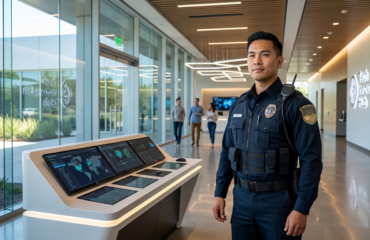
Unmonitored front offices: A close-up of a school visitor check-in desk inside an empty administration lobby reveals an unmonitored digital security monitor displaying hallway footage. No one is watching. This scenario is alarmingly common. Understaffed front offices, distracted receptionists, and inadequate visitor management systems allow unauthorized individuals to bypass screenings.
Inconsistent access control: Propped doors, broken locks, and malfunctioning gate systems create opportunities for unauthorized entry. Security audits frequently find that doors intended to remain locked are propped open for convenience.
Inadequate surveillance coverage: Blind spots in camera coverage, outdated equipment, and footage that isn’t actively monitored reduce the effectiveness of surveillance systems.
After-hours vulnerabilities: Campuses are often empty at night but remain accessible. Theft, vandalism, and unauthorized activities occur when no one is watching.
State tracking warns of a rise in unauthorized trespassers bypassing front office screenings during school hours.
This trend is documented in incident reports across California. Individuals posing as parents, vendors, or contractors gain access to campuses and, in some cases, commit crimes or cause disruptions before their presence is detected.
What Professional School Security Actually Looks Like
Enforce your Education Code safety mandates. Partner with certified campus protection.
Professional school security goes far beyond a guard at the front door. It is a comprehensive, multi-layered approach to campus safety.
1. Perimeter Security and Access Control
The first line of defense is the perimeter. Professional security providers assess and secure campus boundaries.
Key measures include:
- Controlled access points with security personnel
- Visitor check-in systems with ID verification and badge issuance
- Locked and monitored gates during school hours
- Motion-sensor lighting for nighttime security
- Regular perimeter patrols to identify breaches
“Securing the school’s perimeter prevents unauthorized access,” according to Secure Guard’s guide on physical security for schools. “Tall, sturdy fencing around the property, gated entryways with controlled access, and motion-sensor lighting for nighttime security” are essential components.
2. Visible Security Presence
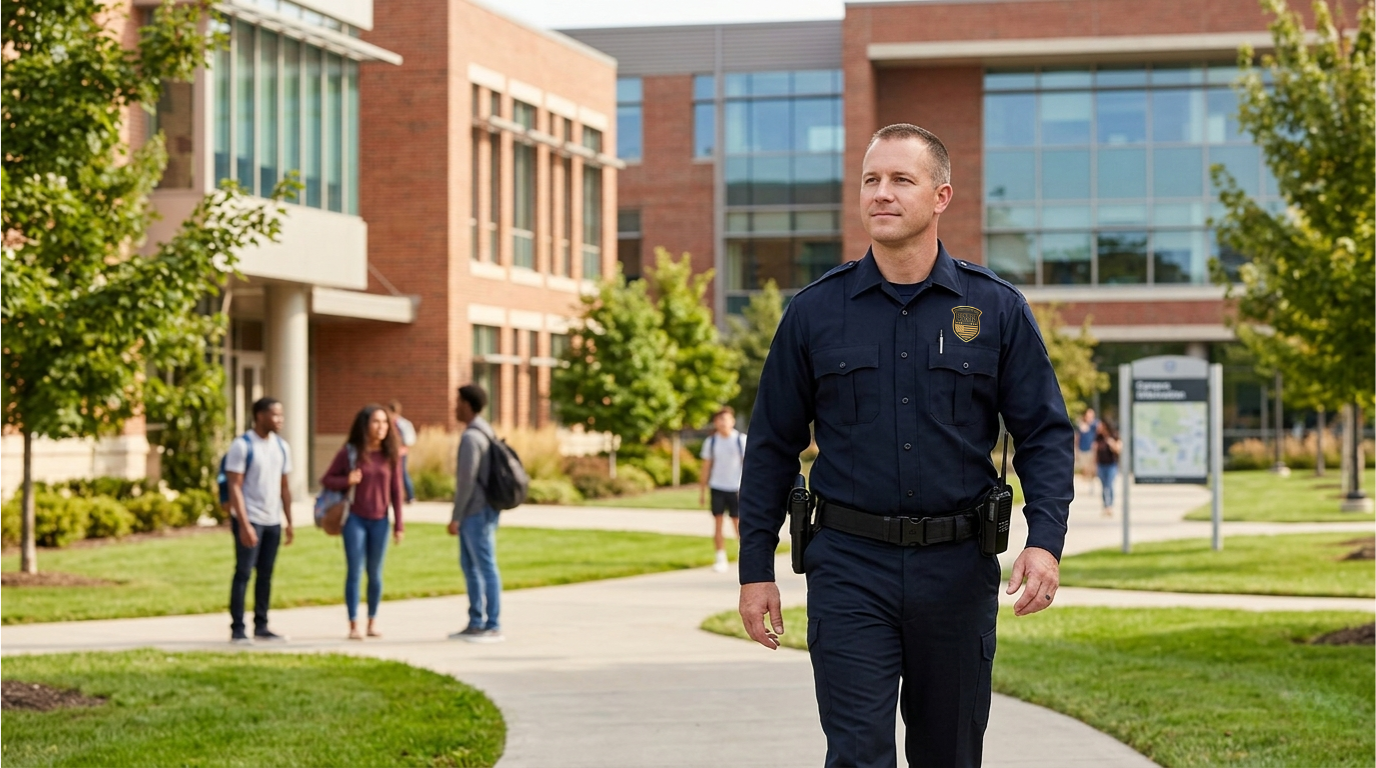
A sharp, professional security guard in a crisp, dark uniform standing alert near a school perimeter gate, actively monitoring the entrance.
This image represents the most effective deterrent to campus crime. A highly visible security presence:
- Discourages unauthorized individuals from attempting entry
- Reassures students, parents, and staff
- Provides immediate response capability when incidents occur
“Campus security officers are trained in Crime Prevention Through Environmental Design (CPTED) principles,” notes Secure Guard’s campus security patrol guide. “During their patrols, they actively identify and report environmental factors that could encourage crime, such as poor lighting, overgrown shrubbery that provides concealment, or malfunctioning access points on campus buildings.”
3. Visitor Management Systems
A digital visitor check-in system helps track who enters the school.
Essential features include:
- ID scanning for background checks
- Visitor badges with time limits
- Integration with sex offender databases
- Electronic logs for audit purposes
- Escort requirements for unaccompanied visitors
“A digital visitor check-in system helps track who enters the school,” according to physical security best practices. “Features include ID scanning for background checks, visitor badges with time limits, and integration with law enforcement databases. This ensures only approved individuals gain access.”
4. Surveillance and Monitoring
Well-placed CCTV systems act as both deterrents and investigative tools.
Effective surveillance includes:
- High-definition cameras covering entrances, hallways, parking lots, and common areas
- Real-time monitoring by security personnel
- Recorded footage storage for incident investigations
- Integration with emergency response systems
“Visible cameras discourage misconduct and help identify suspicious behavior,” according to school security experts.
5. Emergency Response and Crisis Management
When emergencies occur, trained security personnel are often the first to arrive.
Emergency response capabilities include:
- First aid and CPR certification
- Fire safety and evacuation coordination
- Lockdown protocol implementation
- Coordination with local law enforcement and fire departments
- Active threat response training
“Whether it’s a medical emergency, a fire alarm, a violent altercation, or a more severe threat, campus security patrols are often the first to arrive,” notes campus security guidance. “They can provide immediate first aid, secure the area, and begin implementing emergency protocols while waiting for police, fire, or EMS to arrive.”
6. Patrols Beyond the Perimeter
Professional school security includes mobile patrols that cover the entire campus.
Patrol functions include:
- Checking doors and windows for security breaches
- Monitoring parking lots and student drop-off areas
- Identifying and reporting maintenance issues that create vulnerabilities
- Providing safety escorts for students, staff, and visitors
- Enforcing parking and traffic regulations
“The unpredictable nature of mobile security patrols—on foot, in vehicles, and sometimes on bicycles—ensures there are no ‘safe’ times or places for a criminal to operate. This consistent presence significantly reduces opportunities for property crime.”
7. Security Training and Drills
Even the best security systems are ineffective without proper training.
Training requirements include:
- Regular lockdown, evacuation, and shelter-in-place drills
- Staff training on threat recognition and reporting
- Student education on safety protocols
- Coordination drills with local law enforcement
“A security-conscious culture ensures everyone contributes to a safer environment,” according to Secure Guard’s physical security guide.
Special Considerations for California Schools
SB 652 and Updated Training Requirements
Beginning January 1, 2026, under SB 652, the 8-hour pre-registration security guard course must be completed within six months of application and delivered by a single BSIS-licensed training provider.
What this means for schools: When contracting with security providers, verify that guards have completed current training requirements. Non-compliance exposes districts to liability.
Clery Act Compliance for Colleges
For colleges and universities receiving federal financial aid, the Jeanne Clery Disclosure of Campus Security Policy and Campus Crime Statistics Act requires:
- Annual disclosure of campus crime statistics
- Maintenance of a daily crime log
- Issuance of timely warnings about Clery Act crimes
- Development of emergency response and evacuation procedures
Professional security providers assist with Clery Act compliance through incident documentation, reporting, and coordination with campus safety authorities.
The Role of School Resource Officers vs. Contract Security
Many California schools use a hybrid model: School Resource Officers (SROs) from local police departments handle law enforcement functions, while contract security guards from providers like Secure Guard manage access control, patrols, and non-law enforcement security functions.
Contract security officers are often more cost-effective and provide greater flexibility than sworn law enforcement for routine security functions. They can be deployed during specific hours, for special events, or for temporary coverage needs.
The Secure Guard Difference for California Schools
At Secure Guard Security Services, we specialize in educational facility protection.
What sets us apart:
- BSIS-compliant training: All security personnel assigned to schools complete the required 24-hour school security training course under Business and Professions Code section 7583.45.
- California-specific expertise: We understand the unique challenges and regulations facing educational institutions in California, including Education Code safety plan requirements and coordination with local law enforcement.
- Specialized training: Our campus security officers receive training in de-escalation techniques specific to diverse student populations, mandated reporter awareness, child safeguarding, and active threat response.
- Technology integration: The Secure Track system provides real-time reporting, GPS-verified patrols, and incident documentation.
- Flexible solutions: From unarmed security patrols for general campus safety to event security for school gatherings, we scale to your needs.
“Our campus security officers receive training that goes beyond standard security protocols,” notes Secure Guard’s campus security guide. “This includes de-escalation techniques specific to a diverse student population, mental health first aid, FERPA compliance, and inclusive community policing principles.”
Your Next Steps: Securing Your Campus
Safety audits reveal a critical vulnerability: open perimeters. State tracking warns of a rise in unauthorized trespassers bypassing front office screenings during school hours.
These findings are not abstract warnings. They are documented realities. But they are also preventable.
Enforce your Education Code safety mandates. Partner with certified campus protection.
Ready to discuss your school’s security needs?
Secure Guard Security Services offers free, no-obligation security assessments for educational facilities. We’ll evaluate your campus, identify vulnerabilities, and design a security plan tailored to your unique environment—protecting students, staff, and your institution’s reputation.
Enforce your Education Code safety mandates. Partner with certified campus protection. Secure Guard Security Services.
Contact Secure Guard today to schedule your consultation. Serving California schools with integrity, professionalism, and 24/7 reliability since 2005.