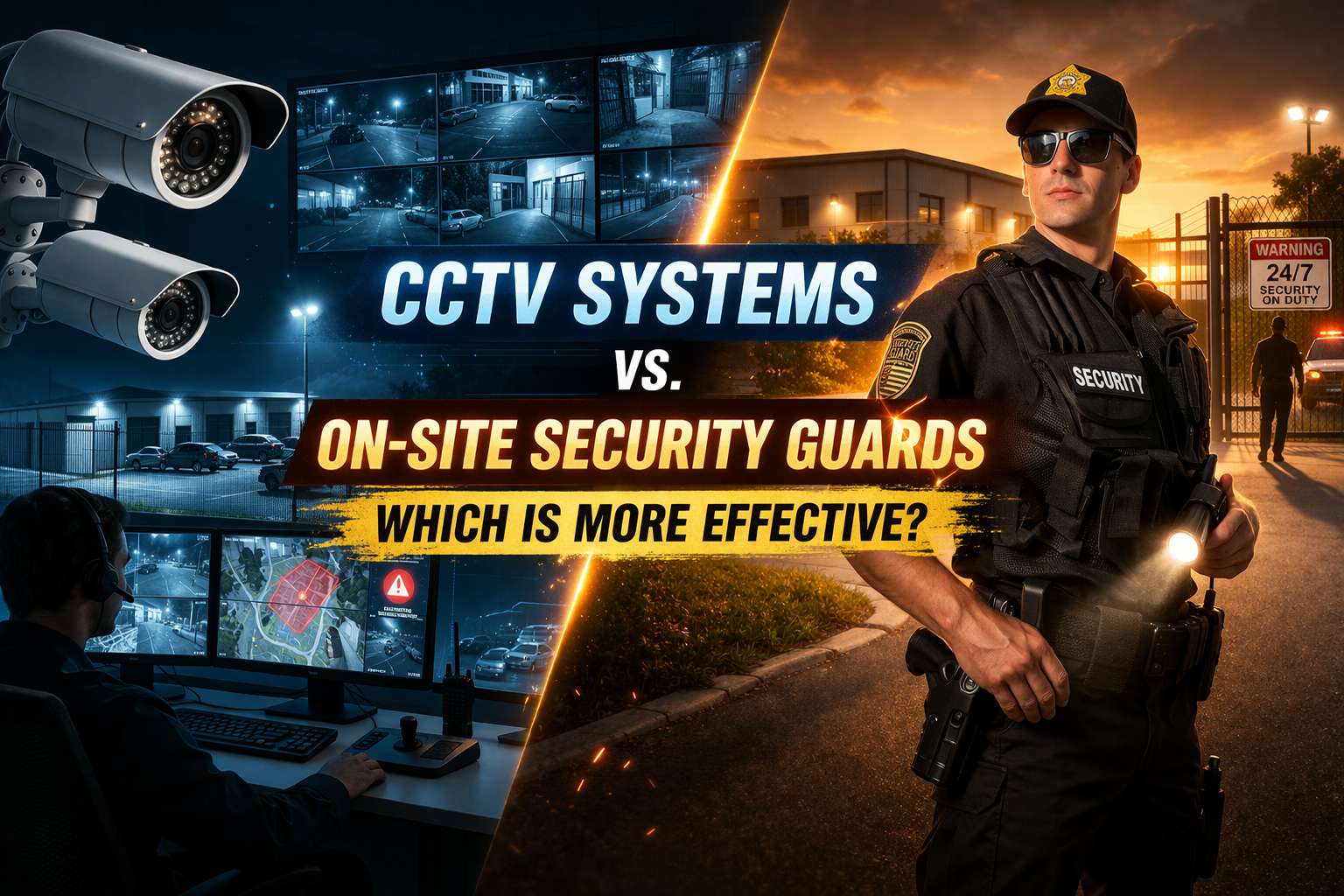
You’re evaluating security options for your property. The proposals land on your desk. One emphasizes state-of-the-art camera systems with remote monitoring. Another focuses on trained guards stationed on-site.
Both have compelling arguments. Both require investment. But which is truly more effective?
The question isn’t new, but the answer has evolved. Technology has advanced dramatically. Professional security training has grown more sophisticated. And the reality is that most properties benefit from both—not one or the other.
At Secure Guard Security Services, we’ve spent 20 years helping California businesses, communities, and property owners answer this exact question. We don’t have a bias toward one solution; we have a bias toward what works.
Here’s an honest comparison to help you decide what’s right for your property.
The Case for CCTV Systems
Modern CCTV systems are powerful tools. Today’s cameras offer capabilities that were science fiction a generation ago.
What CCTV Does Well:
- Continuous Monitoring: Cameras never blink, never sleep, never get distracted. They record everything, 24/7.
- Wide Coverage: A single camera can monitor areas that would require multiple guards to physically patrol.
- Evidence Collection: When incidents occur, video footage provides irrefutable documentation for investigations, insurance claims, and legal proceedings.
- Remote Access: Modern systems allow owners and managers to view live feeds from anywhere via smartphone or computer.
- Cost Efficiency: For covering large areas or multiple locations, cameras can be more cost-effective than deploying numerous guards.
What CCTV Cannot Do:
- Intervene: Cameras record crime; they don’t stop it. A camera watches someone break into your property—it doesn’t call for help or confront the intruder.
- Use Judgment: Cameras can’t distinguish between a delivery driver and a burglar. They can’t assess body language or detect suspicious behavior that doesn’t match a pre-programmed trigger.
- Provide Customer Service: A camera can’t greet visitors, give directions, or make employees feel safe walking to their cars at night.
- Adapt: Fixed cameras have fixed views. They can’t respond to a developing situation by repositioning or following a subject.
- De-escalate: When tensions rise, cameras offer no intervention. They simply record the escalation.
According to industry research from ASIS International , technology alone is rarely sufficient for comprehensive security. Cameras excel at surveillance and documentation—but they cannot replace human judgment and intervention.
The Case for On-Site Security Guards
Professional security guards bring capabilities that no camera can replicate.
What Guards Do Well:
- Deterrence: Visible, uniformed presence is the most effective crime deterrent. Criminals look for easy targets; a guard signals that this property is not easy.
- Intervention: When something happens, guards act. They confront trespassers, de-escalate conflicts, and stop theft in progress.
- Judgment: Guards assess ambiguous situations. Is that person lost or casing the property? Is that noise a maintenance issue or a security breach? Human judgment answers these questions.
- Customer Service: Guards greet visitors, provide directions, and assist employees. They become familiar, trusted faces in the community.
- Emergency Response: Guards are trained to respond to medical emergencies, fires, and security incidents—providing aid and coordinating with first responders while cameras only watch.
What Guards Cannot Do:
- Be Everywhere at Once: Even the most diligent guard can’t monitor every corner of a large property simultaneously.
- See Through Walls: Guards rely on line of sight and patrol routes, which means they may miss activity in areas they aren’t currently covering.
- Operate 24/7 Without Support: Guards need breaks, shift changes, and backup. A single guard cannot provide continuous coverage indefinitely without a team.
- Provide Unlimited Documentation: While guards document their observations, they can’t capture every moment the way cameras do.
The Reality: Most Properties Need Both
Here’s the truth that experienced security professionals know: CCTV and security guards are not competitors. They are partners.
The most effective security programs integrate both, leveraging the strengths of each while compensating for their limitations.
How They Work Together:
- Cameras Extend Guard Reach: A guard in a monitoring station can watch dozens of camera feeds, spotting issues across a large property and dispatching mobile patrols to investigate.
- Guards Verify Camera Alerts: When cameras detect motion in a restricted area, guards provide the human judgment to determine whether it’s a genuine threat or a false alarm.
- Cameras Document Guard Activity: Video footage confirms that patrols occurred, documenting the guard’s presence and actions.
- Guards Respond to Camera Detection: A camera that alerts to after-hours activity becomes actionable when a guard responds to investigate.
At Secure Guard, this integration is central to our approach. Our Secure Track system enables guards to log incidents with photo documentation, while our mobile patrol services ensure rapid response to camera-detected activity.
A Side-by-Side Comparison
| Factor | CCTV Systems | On-Site Security Guards |
|---|---|---|
| Deterrence | Limited (criminals may not notice or care about cameras) | High (visible presence deters most criminals) |
| Intervention | None (records crime but doesn’t stop it) | Immediate (can confront, detain, or de-escalate) |
| Judgment | None (follows programmed parameters) | High (assesses ambiguous situations) |
| Customer Service | None | High (greets visitors, assists employees) |
| Emergency Response | Alerts authorities but doesn’t act | First responder capability |
| Coverage | Continuous, wide area | Limited by line of sight and patrol routes |
| Documentation | Excellent (continuous recording) | Good (logs and reports) |
| Cost | Higher upfront, lower ongoing | Lower upfront, higher ongoing |
| 24/7 Operation | Continuous | Requires shift coverage |
When CCTV Alone Makes Sense
There are situations where CCTV systems alone may be sufficient:
- Small properties with low risk: A small retail space in a low-crime area might be adequately covered by cameras, especially with remote monitoring.
- After-hours monitoring only: If your only concern is overnight recording, cameras can capture activity for later review.
- Temporary situations: During construction or between tenants, cameras can provide basic surveillance without full-time staffing.
- Budget constraints: When upfront investment is the primary concern, cameras may be the accessible option.
However, even in these scenarios, the limitations remain. Cameras record what happened—they don’t prevent it from happening.
When Guards Alone Make Sense
Similarly, there are situations where guards alone may be appropriate:
- Small properties with high interaction: A boutique hotel or small office building might benefit more from a welcoming guard presence than from extensive camera coverage.
- Events: Temporary events often require crowd management and access control that only human presence provides.
- High-deterrence needs: Properties with visible threats may need the deterrent effect of uniformed guards.
But guards alone have blind spots. Without camera support, even the best guard can’t be everywhere at once.
The Secure Guard Approach: Integrated Protection
At Secure Guard Security Services, we don’t ask clients to choose between technology and human protection. We ask: How can we combine them most effectively for your property?
Our process begins with a thorough security consulting assessment. We evaluate:
- Your property’s layout and access points
- Risk factors specific to your location and industry
- Your budget and operational constraints
- Your goals for security (deterrence, response, documentation, customer experience)
From this assessment, we design a customized plan that may include:
- Armed and unarmed security guards stationed strategically
- Mobile patrol services covering larger areas
- Integration with existing or new CCTV systems
- Secure Track technology for real-time reporting and accountability
- Event security for special gatherings
The result isn’t a choice between cameras and guards. It’s a unified security ecosystem where each element reinforces the others.
What the Experts Say
Security industry leaders emphasize integration over either/or choices.
The International Foundation for Protection Officers notes that comprehensive security programs combine physical security measures, technology, and trained personnel. No single element is sufficient.
The California Bureau of Security and Investigative Services (BSIS) regulates security guards but doesn’t mandate technology—recognizing that human judgment remains central to effective protection.
And property owners who have experienced both understand the value of integration. As one Secure Guard client noted in a testimonial , our guards are “very professional”—and their effectiveness is enhanced by the tools and systems we provide.
Making the Right Choice for Your Property
So how do you decide what’s right for you?
Ask yourself these questions:
- What am I trying to prevent? Theft? Vandalism? Unauthorized access? Workplace violence? Different threats require different approaches.
- What is my tolerance for risk? If something happens, will I be satisfied with footage of the incident, or do I need someone who can intervene?
- What is my property’s layout? Large, open properties may benefit from camera coverage. Properties with many access points may need guard presence.
- What is my budget? Consider both upfront costs and ongoing expenses.
- What is the nature of my business? Do employees and customers expect human interaction? Is the primary goal deterrence or documentation?
Honest advice:
If your primary concern is having evidence after an incident, a good CCTV system may serve your needs.
If your primary concern is preventing incidents from happening in the first place, and having someone respond when they do—professional security guards are essential.
But for most properties, the answer is both. A security guard with camera support is more effective than either alone. Cameras monitored by trained professionals provide coverage that neither can achieve independently.
The Bottom Line
The question “CCTV vs. security guards” is outdated. In modern security, it’s not an either/or choice. It’s about integration.
Cameras provide continuous coverage and indisputable documentation. Guards provide deterrence, judgment, intervention, and human connection. Together, they create protection that is greater than the sum of its parts.
At Secure Guard Security Services, we’ve spent 20 years helping California property owners build exactly this kind of integrated protection. We don’t sell cameras. We don’t sell guards. We sell peace of mind—and we use every tool available to deliver it.
Your Next Steps
Ready to evaluate your property’s security needs? Start with a professional assessment.
Secure Guard Security Services offers free, no-obligation consultations. We’ll walk your property, understand your concerns, and provide honest recommendations about what combination of technology and human presence makes sense for your unique situation.
Don’t choose between cameras and guards when you can have the best of both.
Contact Secure Guard today to schedule your consultation. Serving California with integrity, professionalism, and 24/7 reliability since 2005.